

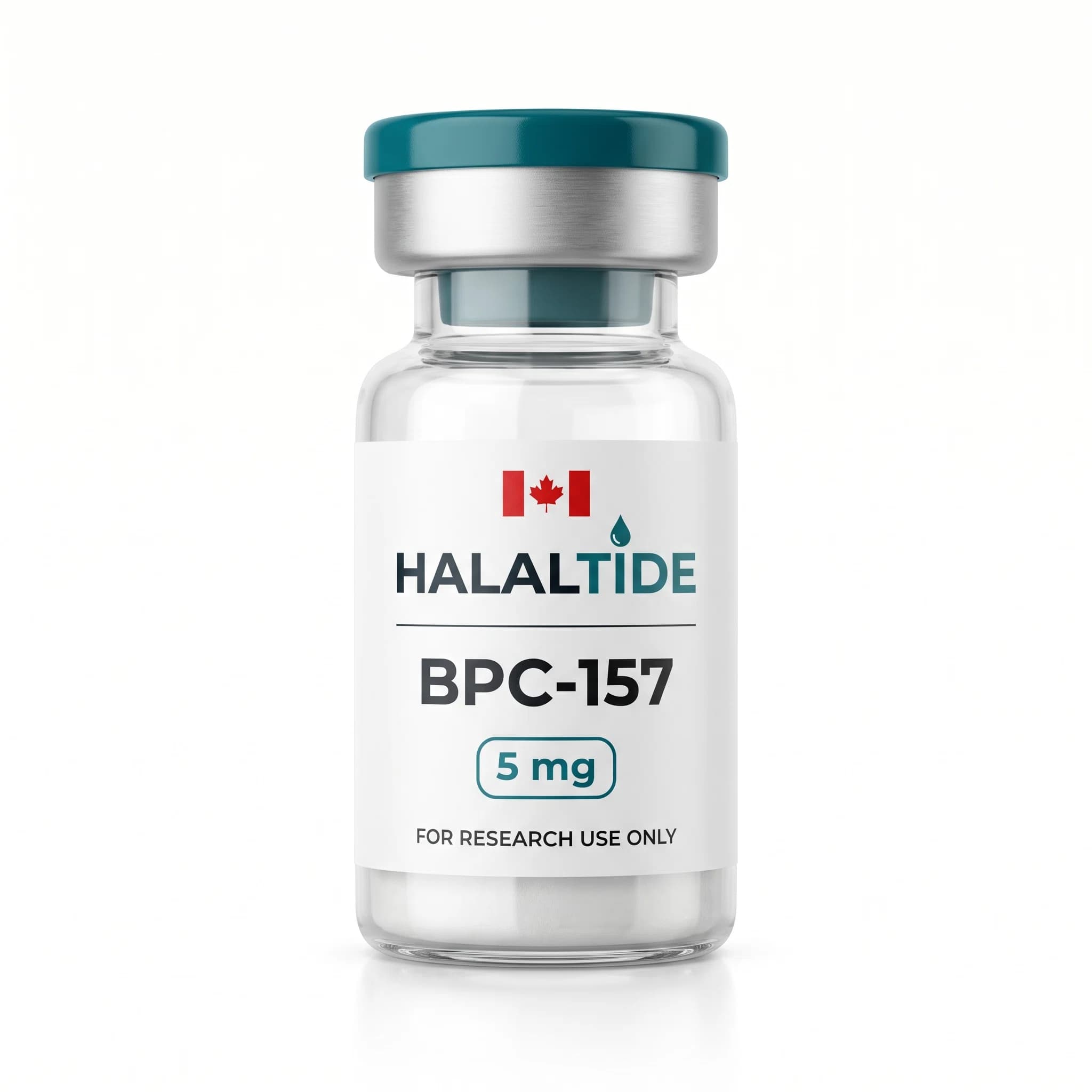
 Lyophilized powder · clear sterile vial
Chromatogram and spectrum panels summarize the published certificate for batch TL-BPC157-260519-02. Look up certificate
BPC-157 Research Peptide
For laboratory research use only
Synthetic pentadecapeptide studied in tissue-repair models.
15% first-order discount (code HLAL15) — enter at cart or checkout.
- ✓Ships from Canada
- ✓98.91% verified purity
- ✓Lost in transit? Free reship
Specification
- CAS number
- 137525-51-0
- Molecular formula
- C62H98N16O22
- Molecular weight
- 1419.53 g/mol
- Sequence
- Gly-Glu-Pro-Pro-Pro-Gly-Lys-Pro-Ala-Asp-Asp-Ala-Gly-Leu-Val
- Form
- Lyophilized powder, sterile vial
- Half-life
- ~4 hours (in vitro estimate)
- Synonyms
- Body Protection Compound 157, PL 14736
Research background
BPC-157 is a synthetic peptide derived from a sequence identified in gastric juice. It has been widely used as a reference compound in in-vitro and animal models of soft-tissue and gastrointestinal repair.
Published studies have examined its interaction with angiogenic signalling and growth-factor pathways. Reported findings are preclinical and describe the compound's behaviour in laboratory models only.
Selected references
- Stable gastric pentadecapeptide BPC 157: mechanisms in tissue healingdoi:10.2174/1381612820666140130201406
- BPC 157 and the central nervous systemdoi:10.3390/biomedicines10122956
Researcher feedback
Moderated for research relevance. Comments describing human use are not published.
Spec table on the product page matched what we needed for our lab notebook — CAS, sequence, and MW all present.
Order confirmation included the lot reference we needed to cross-check against the public COA database.
More in Recovery & Tissue
Wolverine
BPC-157 + TB-500 Blend
Combined pentadecapeptide / Thymosin β4 fragment research blend.
GHK-Cu
Copper tripeptide studied in extracellular-matrix models.
GLOW Blend
BPC-157 · TB-500 · GHK-Cu
BPC-157, TB-500, and GHK-Cu co-formulated research blend.